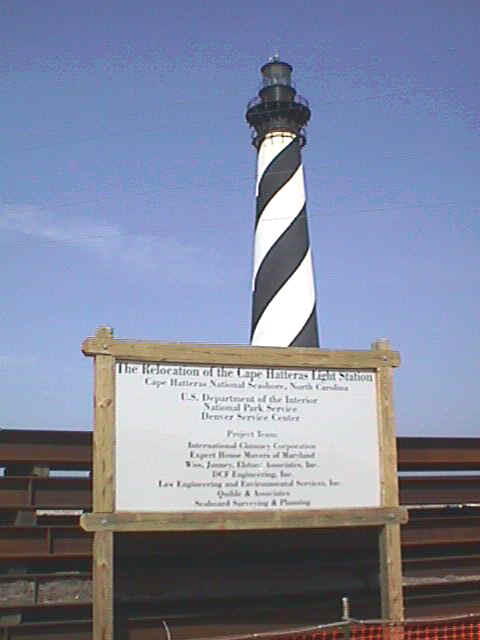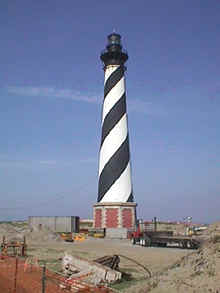

The above photo, showing the lighthouse and the move corridor is from the booklet "Moving Hatteras - Relocating the Cape Hatteras Light Station to Safety" by Cheryl Shelton-Roberts and Bruce Roberts. I picked this book up at the Cape Hatteras Lighthouse in June 1999, but I've seen it at many other lighthouses on the east coast. It's a great little book explaining all the logistics of the 2900 foot move in great detail.
| There
has been a lighthouse at Cape Hatteras since 1803 when the first tower was built. Built by
Henry Dearborn, it was an eight-sided sandstone tower, built on a 20-foot tall sand hill. Eighteen open-flame lamps with individual reflectors created the light for the tower. But no matter how well the keeper tended the lights, they were just not powerful enough to reach out across the dangerous underwater ridges of Diamond Shoals. In March of 1851 a review board recommended that a new Fresnel lens be installed at Cape Hatteras. In 1854 the first tower was heightened to 140 feet and a first order Fresnel lens was installed. This light was many times stronger than the original reflector lights. The tower was also painted white for the first 75 feet, so that it would stand out against the green foliage in the background when viewed from the sea. The rest of the tower to the top was painted red to make it stand out against a blue sky. This tower served well until after the civil war when it was discovered that the aging eroding sandstone structure had irreparable cracks in it. In March of 1867 Congress appropriated $75,000 for a new lighthouse, the very best that could be built. Dexter Stetson was chosen as the construction foreman of the new Cape Hatteras Lighthouse. Work began in November of 1868. When the first excavation for the massive Granite, brick and iron tower was begun, Stetson discovered that he could only dig down about six feet before hitting hard, compact sand. Though he had the use of pile drivers, he decided to use the naturally hard subsurface to lay 3 courses of yellow pine timbers, which would serve as the first layer of the foundation. Submerged below the fresh water table, Stetson knew the timbers would remain steel-strong for many years to come. The monster tower was built of the very best materials available. One and a quarter million dark red bricks came from the kilns along the James River. The dressed granite for the quoins came from Vermont, and an enduring iron stairway was cast by Bartlett & Robbins. Despite delays and the harshness of the elements at the Cape, Stetson and his crews completed the 198-foot tall structure in December of 1870. The tower was topped off with a twenty-four panel, first order Fresnel lens. In 1873 The Cape Hatteras Lighthouse received its black and white spirals that made it world-renowned. In those days, the lighthouse was about 1600 feet from high tide. But over the years, the Barrier Island has migrated southwesterly. By the 1920's the ocean had advanced to within 300 feet. Since then millions of dollars have been invested in beach renourishment, groins, huge sandbags, artificial seaweed and other short-term protection measures. None of these have worked. In 1987 the National Park Service asked the National Academy of Sciences to study the situation and provide definitive advice on how to Save Cape Hatteras Lighthouse. The Academy developed ten options for saving the lighthouse, identifying the wood timbers of the foundation as the "Achilles heel' of the structure.
As long as the sand surrounding the foundation remains in place and the timbers remain in fresh water like they were placed in 1869, the foundation is secure. If a storm erodes the sand, or the fresh water is disturbed by salt-water intrusion, the timbers will begin to rot and the foundation will eventually fail. With the ocean moving increasingly closer to the lighthouse each year, the likelihood of salt-water intrusion increases. During a storm in 1994, storm waves actually reached the base of the lighthouse. The best solution to the problem – Move the Lighthouse. And that’s what is going on right now. As Elizabeth and I made our way toward the Outer Banks, I wondered just how much of the actual move we would be able to see. I had been reading about it and looking at it happen on the Internet for many months. The truth is, you can’t see a whole lot of it from the base of the Lighthouse. They won’t let you very close at all right now. There are many visitors, and folks from the National Park Service are there to answer your questions and tell you all about it. You can even hike into the tick-infested woods and see the move corridor, but that’s about it. You can’t get close to the new foundation or the lighthouse. But it’s still a cool place to visit. And being there while history is in the making is something worth doing. In the booklet "Moving Hatteras – Relocating the Cape Hatteras Light Station to safety", by Cheryl Shelton-Roberts and Bruce Roberts, the book I got much of the information used in this story from, is the following Observation. "It has been the policy of the US Lighthouse Service, the people who built the Cape Hatteras Lighthouse in 1870, to move their lights out of harm’s way when erosion threatened. Many smaller lights were moved and some, like the Lighthouse at Hunting Island, South Carolina, were constructed of iron plates bolted together so they be disassembled and moved to safety as the ocean advanced. In a historical sense, the Park Service is following the Lighthouse Service tradition in making the move to safety." After the move is finished, future generations will be able to climb the spiral stairs again and see the Atlantic Ocean from a safe distance, just as the keepers did in 1870.
|


The above photos were lifted from the news updates sent by Cheryl Roberts. You
can see these and more at the http://ecnews.outer-banks.com/
Website. WITN-TV of Greenville/Washington, North Carolina has installed a
camera so still views of the ongoing work at the Cape Hatteras Light Station can be seen.
You can find this at http://www.nps.gov/caha/livecam.htm
with updates also posted on the www.nps.gov/caha/lrp.htm
WebPages as well.
For those of you just joining us, an archive of these updates to bring you up-to-speed can
be accessed at http://www.outer-banks.com/lighthouse-society/articles.cfm