Lighthouse Trips by Jerry Perlman
My Observations on Lighthouses and field trips to Lighthouses on the Atlantic Coast, The
Northern California Coast and Hawaii. (so far).
I became a full time resident of Tybee Island in 1990. Shortly after that while on a trip to the Outer Banks of North Carolina, I visited Okracoke and Cape Hatteras Lighthouses. I returned from this trip inspired, and began to take a great interest in the Lighthouse here on Tybee, on Cockspur Island and other nearby lighthouses. Over the last few years I've made trips to as many nearby lighthouses as possible, and some as far away as Hawaii. On each and every trip my Wife Elizabeth and I take now, looking for Lighthouses is at the top of our list. Assembled here is a place that has pictures I've taken, some I've collected, links and information about, and links to almost every other lighthouse in the USA and the rest of the world that I could find. I hope you enjoy my Observations. I'll be adding stuff here as I find it, and keep you up to date on my travels to lighthouses.
Click Here for a complete list of Lighthouse Trips.
| The Tybee Island Lighthouse is just Outside my front door here on Tybee Island, Georgia. Elizabeth, my wife, and I really enjoy having a lighthouse as a neighbor. In fact, it's presence is what inspired this lighthouse collection and our Trips to as many lighthouses as possible. | 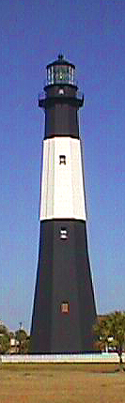 |
 |
Today Tybee Light is maintained by the Tybee Island Historical Society which maintains the grounds as a museum through a lease with the Coast Guard. The Tybee Island Lighthouse is still an active light and aid to navigation. Tybee is very unusual in that all of it's support buildings are intact. The site includes a head keeper's house, two assistant keeper's houses, a summer kitchen, and fuel storage building. The tower is open for climbing and there is a gift shop. It costs a couple of bucks but you also get to see the Tybee Museum across the street. |
TYBEE LIGHTHOUSE RESTORATION IS COMPLETE. The light was turned back on in a ceremony on Sunday, February 28th 1999.
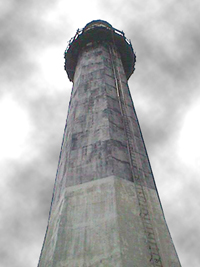
Tybee Light just after restoration began. Notice the ladder going up the side and the platform around the lantern room. |
It was sunny, but cold and windy on the afternoon of Sunday February 28th. It would have to get a lot worse to shut this event down. People had been walking by our house since morning, and I saw a horse carriage pass the end of our street. Early afternoon the coast guard helicopter buzzed the house a few times. But it was getting to be dark when the real crowd began to gather at the Lighthouse on Tybee. The golden light of sunset lit the freshly painted Lighthouse. A large crowd had assembled at it's base and in the open field surrounding the area when the sound of bagpipes echoed Amazing Grace. Ghostly red pyrotechnics illuminated the Lantern-room and smoke filled the air as the light came back on. Our lighthouse was back, and it has never looked as good as it does right now. A silky smooth, perfect paint job covers the freshly repaired structure. For 5 months the light was off as repairs and renovations took place. It had been 131 years, since the light was last turned off for any length of time. The light was extinguished and a protective covering was built around the lens as the work progressed. A temporary light was put up on the ocean side of the Lighthouse as a beacon for ships at sea. Extensive renovations took place. Elizabeth and I were looking forward to seeing our engraved brick in the new walkway, but it wasn't ready on Sunday. After a decade of dedication and hard work, the efforts of the Tybee Island Historical Society have finally brought the dream of a fully restored Tybee Lighthouse to reality.
In the photo above, you can see the work going on to patch all the cracks in the structure. Many more cracks appeared in the portion painted black, this because the black part heated up more than the light portions. Extensive work was also done on the lantern room. The work progressed slow because of the care used to prevent any damage to the lens. Only 2 people could work in this room at a time. Plywood covered the outside windows of the lantern room, this was also to prevent any damage to the incredibly valuable lens. The Lighthouse has suffered greatly over the past few years from lack of funds to maintain the historic structure. Restoration was partially funded through a Federal Department of Transportation program called I.S.T.E.A. or the Intermodal Surface Transportation Efficiency Act, enacted by congress in 1991 to provide funds to enhance and improve historic transportation facilities. The program is designed to reimburse sponsors of restoration projects for up to 80% of the cost. In the case of the Tybee Lighthouse restoration all of the cost must be paid by the Historical Society who then applies for reimbursement from the Georgia Department of Transportation, which administers the Federal program.
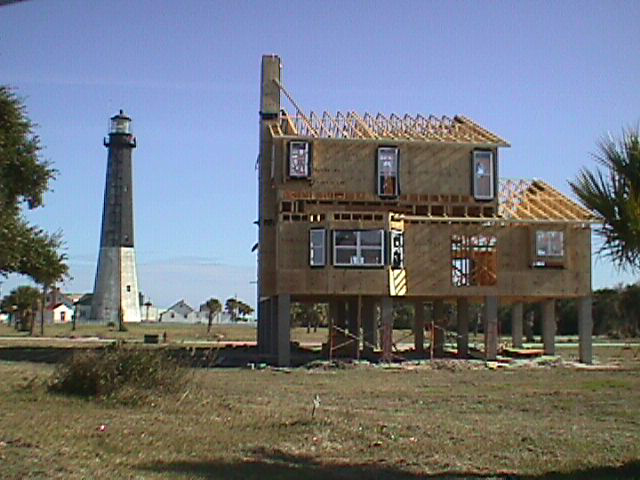
The first of new housing adjacent to the lighthouse going up on the old go-cart track.
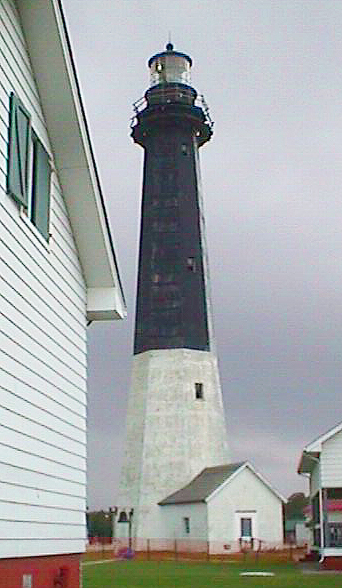
Lighthouse just before restoration began in October 1998
Lighthouse with new daymark being painted. |
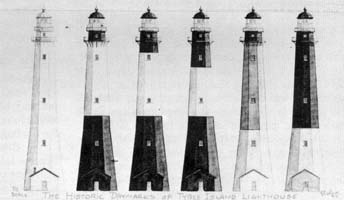
Tybee Island Lighthouse Returns To It’s Historic Day Mark
|
|
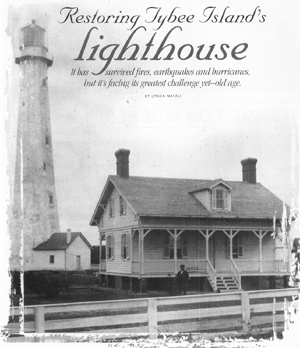 Old Tybee Lighthouse |
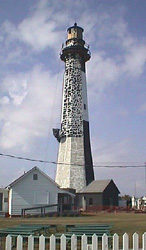
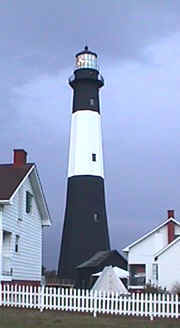 Tybee Lighthouse with new daymark March 1999 |
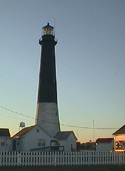
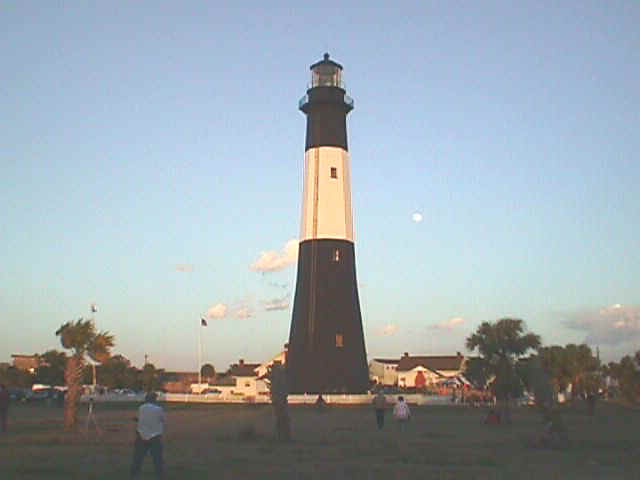
Tybee Lighthouse at sunset January 1998 |
| This article appeared about a year before the
restoration began and I had it on an old web page. I thought I'd include it here for
your reference and entertainment. Jim
Kluttz, President of the Historical Society stated that even with the Federal program, the
Society would have had great difficulty starting the project and paying the cost up front
had it not been for the additional support of the contribution of over $63,000 by Bill
Younaer and his Harbour Lights Collector Society. Kluttz explained that " in order to
qualify for these federal funds an applicant had to commit to providing all the funds
needed to complete the project. Even though the Society through mostly volunteer efforts
has managed to save some monies earmarked for the Lighthouse restoration, it would have
taken at least another year to raise the $63,000 made available by Harbour Lights Society
members." That extra year would have delayed the project and possibly prevented the
Society from meeting the deadline for committing local funds needed to receive federal
reimbursement. Work on the Tybee Lighthouse, scheduled to
begin in December, will include repair of all metal work, brick and stucco; restoration of
all windows and window openings which were modified in 1970; Installation of special
protective glass around the lens currently valued at over $3 million dollars; and
repainting of the interior and exterior of the Lighthouse. Jim Kluttz explained that part
of that repainting of the exterior would include "returning the exterior paint
pattern, called a 'day mark' to its most historic character, as a black lighthouse with a
white band in the middle". That "day mark' according to research conducted by
the Staff of the Historical Society, lasted from 1916 to 1965 and will be the only
"day mark" with that characteristic in the entire nation. The paint pattern,
which exists today, was done in 1970 and there are at least four other Lighthouses in
America with similar paint patterns according to the National Park Service's Inventory of
Lighthouses. The "day mark" of the Tybee Lighthouse changed over six times from
1867 to 1970. (See Day Mark story below) According to Kluttz there will be a huge
re-lighting celebration sometimes early spring of 1998 and a bronze plaque honoring major
contributors to the project as well as the brick walks will be dedicated. Lighthouse
lovers who donated $50.00 to the restoration project will pay for the walks. The bricks
will be engraved with brick sponsor names. Kluttz indicated that the restoration of the
Tybee Lighthouse is only the first step in a long campaign to restore the entire Tybee
Light Station made up of six historic support buildings. Once completely restored at an
estimated cost of an additional $750,000; the Tybee Light Station one of only twenty
complete Light Stations remaining in America will be eligible for National Historic
Landmark status. |
Morris Island Lighthouse, Charleston South Carolina
Pigeon Point Lighthouse, California Coast
Point Pinos Lighthouse, Pebble Beach, California Coast
Cockspur Island Lighthouse, off the coast of Tybee Island, Georgia
The New Charleston Lighthouse on Sullivan's Island, South Carolina
The Lighthouse and Beacon at Nawiliwili Harbor, Lihue, on the Island of Kauai, Hawaii
Kapoho Lighthouse, Cape Kumukahi, The Big Island of Hawaii
Hunting Island Lighthouse, Near Beaufort, South Carolina
Harbour Town Light, Harbour Town, Hilton Head Island, South Carolina
Ocracoke Lighthouse, Ocracoke Island on the Outer Banks, North Carolina
The Cape Hatteras Lighthouse, Outer Banks, North Carolina
Bodie Island Lighthouse, Outer Banks, North Carolina
The Currituck Beach Lighthouse, Outer Banks, North Carolina
Cape Henry Lighthouses, both Old and New, Virginia Beach, Virginia
The Assateague Island Lighthouse, Virginia Coast
The Hooper Strait Lighthouse at the Chesapeake Bay Maritime Museum
Concord Point Lighthouse at Havre De Grace, Maryland
The Lighthouse at Point Lookout
The Old Fort Washington Lighthouse
Authored 1999 Jerry Perlman - Big Time TV Productions
& OTB - On the Beach
Feel free to use anything on this website.
Original images in most cases. Some images I've lifted from other
websites, some images were given to me by others and I don't know where they came from.
Credit given when the author is known. Almost all
of the original pictures used on this Website were shot with a Sony Mavica MVC-FD5 Digital
Still Camera. These images are then manipulated using Adobe PhotoShop.
Some of the other shots are made using Canon Cameras and Lenses and shot on Kodak
film. The negatives are scanned on a transparency scanner and, like all the digital
images, they are also manipulated using Adobe PhotoShop. Isn't this a wonderful time
to be a photographer. Can you remember what a darkroom smelled like??? I
can't, and I don't care. Just my Observations